
On the 20th of this month, the Minister of the Ministry of Trade, Industry and Energy announced the national strategy to strengthen the competitiveness of the secondary battery industry at the 16th Emergency Economic Livelihood Meeting.
First, the three domestic battery companies, LG Energy Solution, SK On, and Samsung SDI, decided to establish mother factories in Korea. A mother factory is a factory that serves as the center for product development and manufacturing. They plan to build a solid-state battery prototype production factory and announced plans to start production of cobalt-free batteries, including the cylindrical 4680 battery, domestically and produce them overseas.
1. What is a solid-state battery?
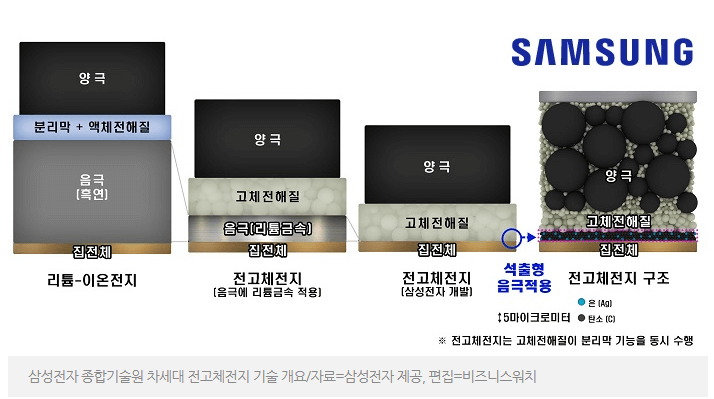
It is a technology that changes the electrolyte, a core component of a lithium-ion battery, from a liquid to a solid, which has the advantage of greatly reducing the risk of fire. The energy density is increased, and it is known to have a range of 800-900 km on a single charge in theory.
If electric vehicles are mass-produced with solid-state batteries, it is expected to address the critical issue of the short driving range in winter due to low temperatures, which is considered a disadvantage of electric cars. It is a noteworthy situation where Korean companies can lead the era of solid-state batteries, also known as the "dream battery," through the world's first commercialization.
As solid-state batteries have shaken up the industry, with battery companies and even automakers competing in development, they are being recognized as a "game changer." According to SNE Research, a battery market research firm, the global production capacity of solid-state batteries is expected to increase from 0.06 GWh in 2020 to 1 GWh in 2025, 149 GWh in 2030, and 950 GWh in 2035.
2. Concentrated support for small and medium-sized companies (materials/parts/equipment)
The government plans to provide concentrated support for companies that produce materials, parts, and equipment. Currently, more than half of the materials used in the battery factories of the three major battery companies under construction are produced by domestic companies, and more than 90% of the equipment used is also domestic. As battery companies expand overseas, it is expected that domestic small and medium-sized companies producing materials, parts, and equipment will also become globally competitive.
In addition, to activate domestic investment by material-producing companies, the government is considering extending the investment tax deduction rate for large companies from 8% to 15% and for small and medium-sized companies from 16% to 25%. The government is also planning to expand the range of recognized deductions for mineral processing technology and extend the application period (until 2024).
To foster equipment-producing companies, the government will designate key equipment technology as a "special support law for the core competitiveness of small and medium-sized companies" and provide concentrated support through R&D and a 500 billion won policy fund. The government is also planning to develop R&D projects for equipment used in the construction of smart factories.
In addition, the government plans to invest more than 350 billion won in the development of ternary batteries, lithium iron phosphate (LFP) batteries, and energy storage systems (ESS). The ternary battery is expected to increase its current driving distance of 500 km to more than 800 km by 2030, while the LFP battery is expected to secure the highest level of technological competitiveness by 2027. The government also announced plans to expand the export scale of ESS by more than five times by 2030.

3. Strengthening the competitiveness of the secondary battery industry - National Strategy Meeting
In addition, at the "National Strategy Meeting for Strengthening the Competitiveness of the Secondary Battery Industry" held at the Blue House's Yeongbin-gwan on the 20th, the government announced that it will promote large-scale research and development (R&D) for the development of next-generation batteries, and carry out R&D on promising batteries such as solid-state, lithium-metal, and lithium-sulfur batteries, and secure the technology for mass production of solid-state batteries for vehicles, the world's first strategy.
At the meeting, the three battery companies announced plans to build production facilities for next-generation batteries, including solid-state batteries, domestically. This is analyzed as a strategy to secure future competitiveness by placing "mother factories", the core of advanced product production and research and development, in the country as batteries rise as a core industry along with semiconductors worldwide. The battery industry has set a goal of completing a solid-state battery test (pilot) line in Korea as early as the first half of this year and entering commercialization by 2026.
Samsung SDI plans to complete a solid-state battery pilot line (S-line) at its Suwon research center in the first half of this year and enter into prototype production in the second half. Samsung SDI has also presented its solid-state battery roadmap and technology development direction at "Auto Shanghai 2023", currently being held in Shanghai, China. Samsung SDI aims to start solid-state battery production in 2027. The industry is viewing Samsung's solid-state battery technology as having reached a significant level of advancement.
LG Energy Solution is also actively engaged in R&D for solid-state batteries. The company aims to commercialize polymer-based solid-state batteries by 2026 and sulfide-based solid-state batteries by 2030. The plan is to first focus on the relatively less challenging polymer-based batteries. SK Innovation plans to establish a solid-state battery pilot line next year and begin commercial production by 2029. The company is currently developing its own lithium metal cathode materials at its next-generation battery research center.

4. Areas of focus for long-term success in the secondary battery industry
In order for Korea to become the first country to commercialize solid-state batteries, there are three key areas of focus. If these three success factors are met in the future, Korea's global position in the secondary battery industry will be greatly strengthened, and it is expected to have a positive impact on domestic secondary battery stock prices.
1) Patents for innovative core technologies
- Patents are important in cutting-edge industries such as battery technology, and it is essential to establish an ecosystem that can secure core technologies at a national level. Currently, Japan holds the most patents related to solid-state batteries. The government and companies such as Toyota and Panasonic are collaborating to develop solid-state batteries. To benchmark this, we also need active investment and technology acquisition from the government in Korea.
2) Continuous investment in materials/parts/equipment and co-growth
- In the battery industry, which is the core of electric vehicles, investment in electrode material supply, parts and equipment development for continuous production is necessary to gain a competitive edge in the rapidly changing global battery market. In particular, as there is a high possibility of overseas production for smooth supply after starting production domestically, the technological and competitive capabilities of the materials and parts industry should be actively encouraged at a global level.
3) Maintaining competitiveness in lithium-ion batteries
- While the advantages of solid-state batteries are clear, setting unrealistic goals for commercialization could be counterproductive as there are still high technological barriers. It is expected that existing lithium-ion batteries will continue for at least 10 years in the future, and if we can take one step closer to the development of solid-state batteries without losing competitiveness in this field, we can gain a competitive advantage in the secondary battery industry.
*This article is a personal opinion based on news articles from various media outlets such as Asia Times, Korean Economy, Maeil Business, and Asia Economics. Investing in a specific industry is solely the responsibility of the individual.
2023.04.21 - [분류 전체보기] - The release of Tesla Cybertruck and its impact on Tesla's stock price
The release of Tesla Cybertruck and its impact on Tesla's stock price
Tesla's Cybertruck, first announced in 2019, was truly innovative. The original production schedule was delayed from 2021, but it is now expected to be produced and delivered to customers for the first time this year in 2023. On April 1st, a Cybertruck pro
once.lifetimechance.co.kr
Will the new electric car 48V voltage standard be a game changer for Tesla's stock price?
Tesla announced at the Investor Day event held on the 1st that they will change the voltage of the electronic devices of their upcoming electric cars from the current 12V to 48V. This seems to be Tesla's firm determination to establish a unique electric ve
once.lifetimechance.co.kr
Amazon joins the generative AI war, Elon Musk seeks to establish an AI startup?
On the 13th, the global number one cloud company, AWS (Amazon Web Services), announced their generative AI tool, Bedrock. Recently, they officially joined the AI competition war between Microsoft and Google. Bedrock is a cloud service for building generati
once.lifetimechance.co.kr
Samsung Electronics (feat. Ferrari, BMW) strengthening its focus on the main vehicle & electric vehicle markets.
On April 11th, Samsung Display announced that it will supply cutting-edge organic light-emitting diode (OLED) panels to Ferrari's next-generation models, a world-renowned supercar brand. This is significant as Samsung Display recently revealed a 4.1 trilli
once.lifetimechance.co.kr